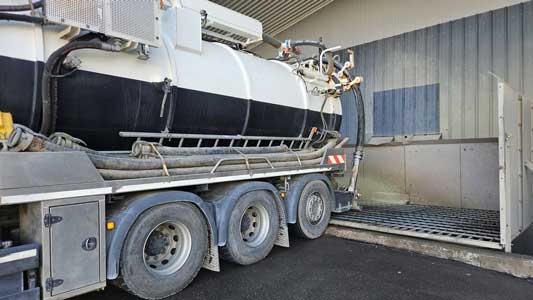
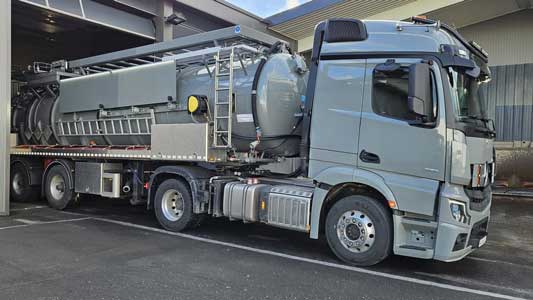
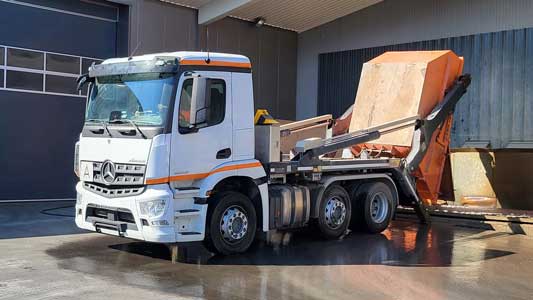
With the BIBKO® INFRATEC recycling plants, waste from sewer cleaning (EAV 200306), from freshwater boreholes (EAV 010504), from street cleaning (EAV 200303), from rainwater retention basins (EAV 170506) in particular, but also other waste can be recycled.
BIBKO® INFRATEC recycling plants use a wet-mechanical recycling process. The waste to be recycled is moved through a water bath. Mineral components <250 µm and impurities are washed out and discharged with the process water. The recycled material ≥250 µm is discharged via a spiral conveyor. To ensure a uniformly high quality of the recycled material, water flows through the recycling plant in countercurrent.
Depending on the input material and the number of processing stages, the following material streams result:
| Material stream 1 | Mineral fraction >250 µm |
| from | Recycling plant |
| Use | Secondary raw material |
| Material stream 2 | Mineral fraction >63 µm |
| from | Fine particle separation |
| Use | Secondary raw material |
| Material stream 3 | Solid |
| from | Chamber filter press / centrifuge |
| Use | Recovery / disposal |
| Material stream 4 | Water (filtrate / centrate) |
| from | Chamber filter press / centrifuge |
| Use | Reuse / discharge |
1-chamber and 2-chamber recycling plants are available for recycling the waste. While the 1-chamber recycling plants are used for washing and removing adhesions to mineral waste, 2-chamber recycling plants are used if the proportion of organic components is also to be reduced.
The 1-chamber recycling units are available with capacities of 20 m³/h and 30 m³/h, depending on the version. The 2-chamber recycling plants with capacities of 15 m³/h, 20 m³/h and 30 m³/h.
There are two options available for feeding waste into the system. A distinction is also made between direct feeding and indirect feeding:
- Feeding via a feed hopper – direct material feeding
- Feeding via a metering buffer – indirect material feeding
While direct feeding sends the material directly to the recycling plant, indirect feeding first sends the material to the dosing buffer. From this buffer, the material is continuously fed to the recycling plant. This ensures a consistently high quality of the recycled material, regardless of feed volume and feed rate.
The dosing buffer enables rapid material feeding, thereby reducing waiting and downtime.
In order to discharge the resulting process water into the public sewer system, it must be analyzed and approved by the authorities.
If discharge is not possible, the process water can be treated. The treatment process consists of two steps:
Step 1: Fine particle separation (Process stage 3)
Removal of mineral components ≥63 µm via fine particle separation
Step 2: Process water recycling (Process stage 4)
Removal of the remaining mineral components via a chamber filter press or centrifuge
The resulting water (chamber filter press: filtrate | centrifuge: centrate) flows into a buffer tank and is recirculated for reuse in the recycling process at the recycling plant. Excess water is discharged.